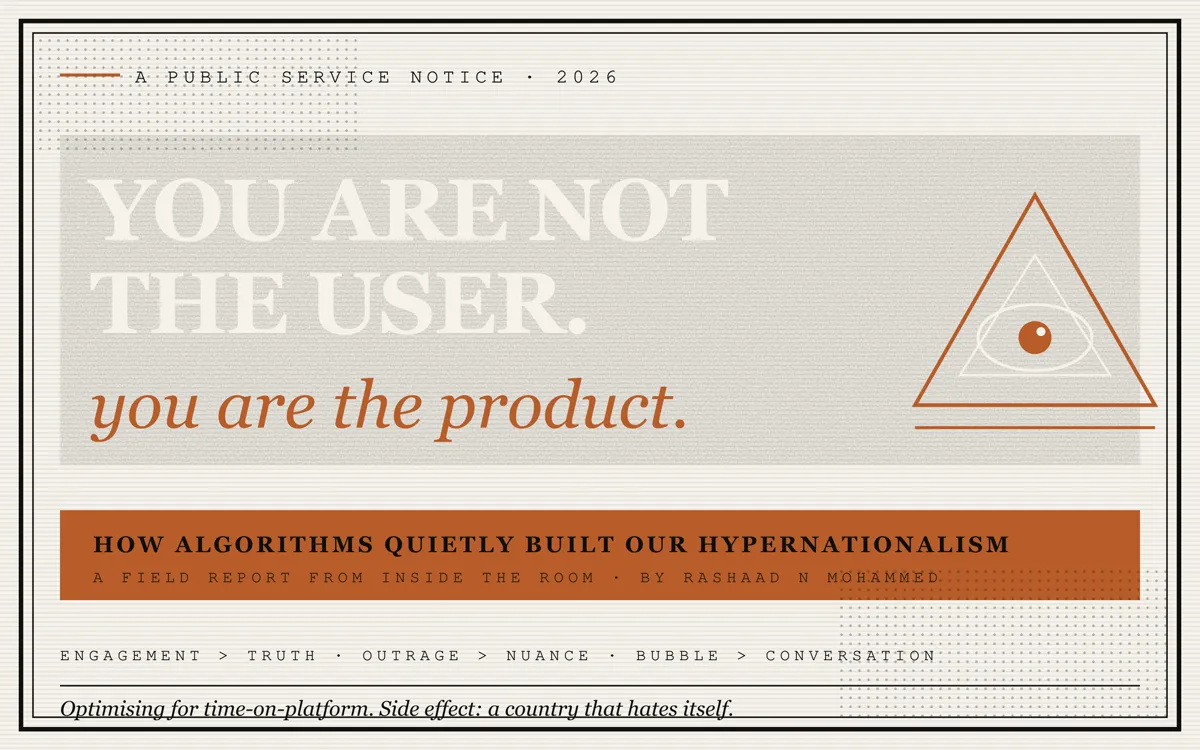
My mom is watching reels.
After every single one, she's commenting, not actually typing, just talking out loud to me. And every comment is defensive. Like she's protecting something. Something emotional. Something she didn't believe this strongly six months ago.
That's where this blog started.
I'm an ML guy. I build the kind of systems that decide what your mom sees next. So let me tell you what's actually happening, not from a journalist's chair, but from inside the room.
The Experiment I Ran on Myself
A few weeks back I tried something.
I usually watch tech content: papers, demos, terminal stuff. For a few days I went against my own grain and started watching right-leaning political content. Just watched. Didn't even like or comment.
I am a centrist by nature. I believe most things have nuance. But within days, my entire feed shifted. Every recommendation, every suggestion column, every reel that auto-played: right-leaning. The deeper I stayed, the deeper it pulled.
By the end of that week, I caught myself nodding along at things I would have argued against a month ago.
The algorithm had me convinced. Quietly. Without me realising.
That's what made me want to write this.
Why This Happens: The Boring Engineering Truth
The algorithm isn't ideological. Nobody at YouTube or Meta wrote a function called make_them_nationalist(). The function they wrote is much simpler, and much worse:
Maximise time spent on platform.
That's it. That's the whole thing. Every recommendation system at every major platform is, at its core, optimising for one number: engagement. How long you stay. How much you scroll. How likely you are to come back tomorrow.
And here's the catch I learned the hard way as a builder: content that triggers identity beats content that triggers thinking. Every time. Outrage holds you longer than nuance. "They are destroying our country" gets more watch-time than "this policy has trade-offs."
So the algorithm, doing exactly what it was told, slowly moves every user toward the most identity-triggering version of whatever they already lean toward.
It's not a conspiracy. It's worse. It's a side effect.
The Case Study Nobody Talks About Enough
July 2018. India.
At least 30 people were killed in mob lynchings across the country in a few months. The trigger was almost identical in every case: WhatsApp forwards. Fake messages claiming child kidnappers were in the area. Forwarded a million times. People went out with sticks. People died.
WhatsApp's "feature", letting any message be forwarded to 256 people at a time, was the algorithmic decision that killed them. Not malicious. Just optimised. After the lynchings, WhatsApp dropped the forward limit to 5 chats. Violence dropped immediately.
The same year: Cambridge Analytica.
Then the Facebook Files in 2021, leaked by Frances Haugen, showed Meta's own internal research concluding their algorithm pushed users toward extremist content because extremist content kept them on Facebook longer. They knew. They had the data. They didn't change it because changing it would lower the engagement number.
This is documented. This isn't paranoia. This is the engineering record.
The Bubble, and the Catch
So here's where my mom comes back into the picture.
The algorithm has built her a bubble. Inside that bubble, she is the victim. There's a clear antagonist, usually whichever group the political party she watches wants her to fear. Everything she sees confirms it. The algorithm makes sure of that.
It's like the frog in the pond who thinks the pond is the world.
But here's the catch I want you to sit with:
The antagonist of her bubble has his own bubble. And in his bubble, she is the antagonist.
Both bubbles are doing exactly the same thing. Both feel justified. Both feel they're defending something. Both are being fed by the same engagement function on the same platforms.
This is why argument doesn't work. You're not arguing with a person. You're arguing with a feed.
When This Becomes Hypernationalism
Political parties learned this faster than the platforms could regulate it.
If you can use the algorithm to shape someone's mindset, what they see, what they fear, what they hate, you don't need to change their values. The algorithm changes them for you.
And the cleanest, most efficient ideology to push through this system is hypernationalism. Because it gives you a country to love and an enemy to hate, all in one frame. Anyone who disagrees becomes "anti-national." Disagreement becomes betrayal. Conversation dies.
That's not patriotism. That's a feedback loop.
What You Can Actually Do
I won't pretend there's a clean fix. The platforms won't change because their revenue is the problem. Regulation is slow. The damage is already a few elections deep.
But three things, today:
- Search instead of scroll. Type what you want to know. Don't let a feed decide.
- Follow people you disagree with. Not to fight them. To break your own bubble.
- Remember: there's a world outside the reel.
The algorithm won't stop. But you can stop being its product.
Eco signing off